
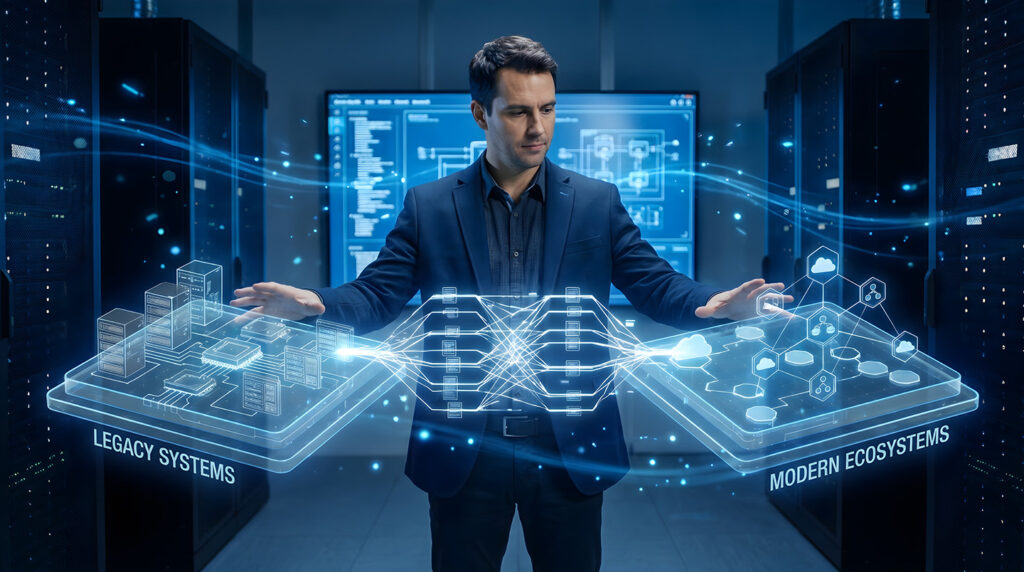
The problem is not necessarily that legacy systems no longer work. In many cases, they contain years of valuable business logic, historical data, and processes that employees understand and depend on every day. The challenge is that these systems were often built for a different era—before real-time dashboards, cloud applications, mobile access, advanced analytics, automation, and AI became important components of everyday operations. As organizations add new technologies around older platforms, the result can become a complicated web of disconnected applications and manual workarounds.
That fragmentation has a real business cost. When production information lives in one system, inventory in another, financial data somewhere else, and managers rely on spreadsheets to bring everything together, visibility suffers. Employees spend valuable time searching for information, re-entering data, reconciling conflicting numbers, and creating reports. Leadership may receive information days or even weeks after something happens, making it harder to identify problems early, respond to changing conditions, or make confident decisions.
Modernization does not have to mean ripping out every existing system and starting over. In fact, for many organizations, that approach can introduce unnecessary cost, disruption, and risk. A more practical strategy is to create a modern digital backbone that connects the systems the business already relies on while providing a foundation for new capabilities. APIs, integrations, cloud services, centralized data platforms, and modern applications can allow information to move between legacy and newer systems without forcing the organization into an immediate, company-wide replacement project.
Once that digital backbone is established, the value of existing data begins to change dramatically. Production, inventory, maintenance, financial, customer, and operational information can be brought together and made available through dashboards and reporting tools. Instead of waiting for someone to assemble a spreadsheet, managers can see current KPIs and operating conditions in one place. Executives gain a more complete view of the business, while frontline teams can access the information they need to respond more quickly to problems and opportunities.
A connected technology foundation also creates the infrastructure needed for the next generation of business tools. Predictive maintenance, AI-assisted forecasting, automated workflows, advanced analytics, and intelligent decision support all depend on accessible, reliable data. Companies that attempt to add AI on top of fragmented systems often discover that the technology is only as useful as the information feeding it. Modernizing the underlying architecture first helps ensure that future investments can deliver measurable business value instead of becoming another disconnected technology layer.
The best modernization strategy therefore begins with the business—not the technology. Which processes create the most manual work? Where are employees entering the same information multiple times? Which reports take too long to produce? Where does leadership lack visibility? And which legacy applications are still delivering value? Answering these questions helps organizations prioritize modernization projects based on operational impact and ROI rather than attempting to replace everything at once.
FocustApps helps manufacturers, logistics organizations, construction companies, and growing businesses transform complex legacy environments into connected, modern technology ecosystems. From integrating older ERP systems and homegrown applications to connecting databases, building custom solutions, modernizing data architecture, and creating dashboards and analytics, FocustApps can develop a modernization roadmap that works with your business today while preparing it for what comes next. You don’t have to replace everything to move forward—you need the right digital backbone connecting it all. Call Becky at 502.465.5104 today to learn how your organization can start turning legacy technology into a foundation for future growth.
