
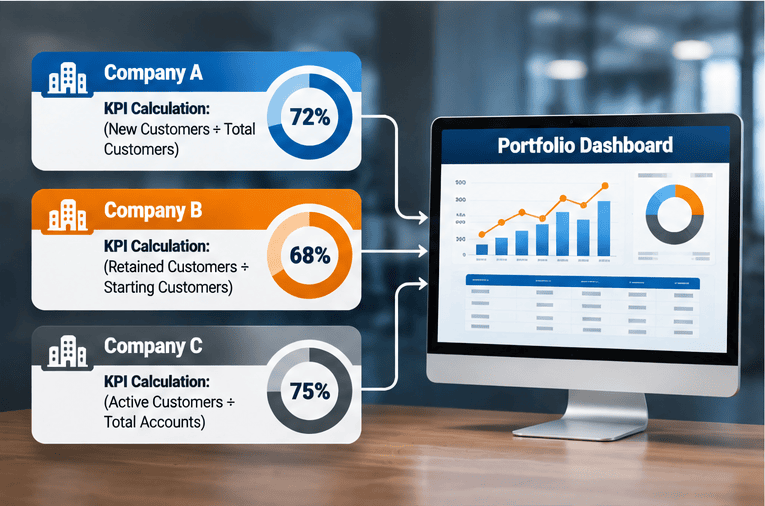
The problem often begins with how individual companies define success. Consider three portfolio companies reporting customer retention. Company A measures the percentage of customers who remain active at the end of the year. Company B calculates retention based on recurring revenue, accounting for upgrades and downgrades. Company C excludes certain customer segments or uses a different reporting period. Each company may be accurately reporting its results according to its internal methodology, yet the investment firm is left comparing three fundamentally different measurements. Without a consistent definition, portfolio-level dashboards can create an illusion of clarity while masking important differences in business performance.
These discrepancies extend well beyond customer retention. EBITDA calculations may include different adjustments, revenue reporting may reflect different recognition practices, and operational metrics may vary according to how each business collects and categorizes information. When these differences are not clearly documented, investment professionals spend valuable time reconciling reports, questioning assumptions, and requesting additional explanations from portfolio company management. What should be a straightforward performance review becomes an exercise in validating the numbers before meaningful analysis can begin. More importantly, inconsistent reporting can influence decisions about capital allocation, operational improvements, and strategic priorities.
The challenge becomes even more significant as private equity firms expand their portfolios. Each acquisition brings its own financial systems, reporting processes, spreadsheets, and management practices. Attempting to force every business into an identical operating model is rarely practical, particularly when companies operate in different industries or markets. However, allowing every company to define core performance indicators independently makes meaningful portfolio comparisons increasingly difficult. The solution is not to eliminate company-specific reporting, but to establish a consistent set of portfolio-level KPI definitions while preserving the operational detail each business needs to manage its own performance.
A more effective approach begins by establishing a shared KPI framework. Investment and operating teams should agree on how critical metrics are defined, calculated, reported, and validated. For example, a standardized customer retention metric should specify the measurement period, eligible customer population, treatment of new customers, and any exclusions. Financial metrics should clearly document adjustments and calculation methodologies, while operational indicators should identify their underlying data sources. These definitions create a common reporting language across the portfolio, allowing investment professionals to compare performance with greater confidence. Individual companies can continue using additional metrics that reflect their unique business models, provided the standardized portfolio measures remain consistent.
Technology plays an important role in making this framework practical. Rather than relying on analysts to manually reconcile spreadsheets each reporting cycle, modern data integration and reporting platforms can connect information from existing financial, operational, and business systems. Solutions such as FocustDNA can help private equity firms consolidate portfolio information, standardize reporting logic, and present consistent KPIs through centralized dashboards. With properly designed data architecture and validation processes, investment teams can reduce repetitive reporting tasks while maintaining visibility into the underlying information supporting each metric. The objective is not simply to display data faster, but to establish confidence that everyone is working from the same definitions and reliable information.
Once portfolio companies report against consistent definitions, investment teams can begin identifying patterns that might otherwise remain hidden. A decline in customer retention across several businesses may reveal a broader market challenge, while differences in operating margins may highlight opportunities to share best practices. Standardized reporting also makes it easier to evaluate performance against investment theses, monitor value creation initiatives, and identify businesses requiring additional support. Instead of debating which numbers are correct, investment professionals can focus on understanding why performance differs and determining what actions will create the greatest value.
For private equity leadership, consistent KPI reporting ultimately strengthens the connection between data and decision-making. Reliable comparisons support more productive portfolio reviews, more informed capital allocation, and clearer communication with investment committees and stakeholders. As firms continue investing in analytics, automation, and AI-driven reporting, standardized KPI definitions become even more important. Sophisticated dashboards and advanced analytical tools cannot compensate for inconsistent underlying measurements. Before private equity firms can achieve meaningful portfolio-wide intelligence, they must first establish a shared understanding of what their numbers actually mean. Because when one KPI produces three different answers, the greatest risk is not the reporting inconsistency itself—it’s the investment decision made without recognizing it. For more information on how we can help you, contact Becky at 502.465.5104.
