
Consider a manufacturing operation that consistently meets its monthly production targets but experiences declining profitability. Production reports show acceptable output, while financial statements reveal increasing labor and operating costs. What the reports may not immediately show is that equipment downtime has resulted in additional overtime, inconsistent material quality has increased rework, and production delays have required expedited shipments to meet customer commitments. Each issue may appear manageable when viewed independently. Together, however, they create a chain of expenses that can significantly reduce the profitability of an otherwise successful operation. Without connecting production, maintenance, labor, and financial information, leadership may see the financial consequences without understanding the operational causes.
Similar challenges exist throughout logistics and warehousing operations. A distribution center may report strong order fulfillment numbers while experiencing higher costs from additional picking labor, inventory discrepancies, inefficient warehouse workflows, or repeated delivery exceptions. Transportation teams may absorb detention charges, fuel surcharges, and expedited freight expenses that are recorded in different systems. In construction, schedule changes, equipment utilization, material waste, and subcontractor delays can create comparable financial pressures. These costs often accumulate across departments and reporting periods, making it difficult to recognize patterns or determine which operational activities are having the greatest impact on margins.
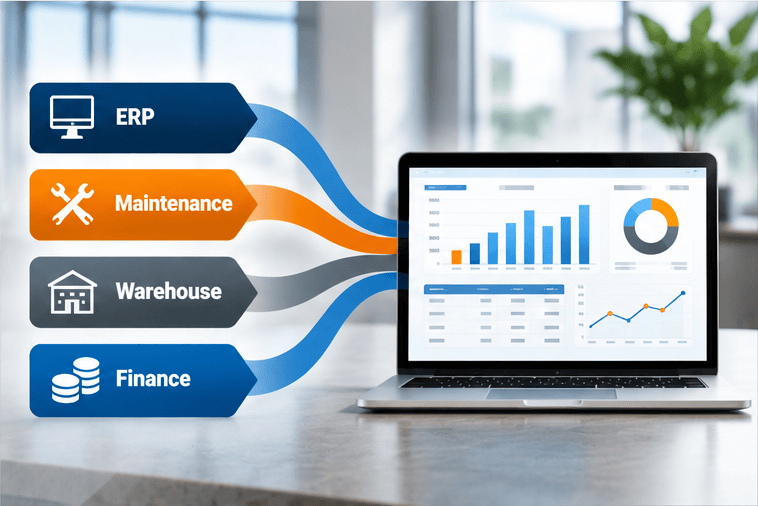
Most organizations already have technology in place to manage these activities. Enterprise resource planning (ERP) systems track financial transactions and business operations, computerized maintenance management systems (CMMS) monitor equipment maintenance, warehouse management systems (WMS) oversee inventory and fulfillment, and transportation management systems (TMS) coordinate shipments. However, when these applications operate independently, the relationship between operational events and financial results can remain unclear. A maintenance system may document recurring equipment failures while the ERP records increased labor expenses, but neither system automatically explains how one contributed to the other. Finance and operations teams are left reconciling spreadsheets, reviewing separate reports, and attempting to piece together what happened after the costs have already occurred.
The challenge becomes more significant when organizations rely on traditional financial reporting alone to evaluate performance. Monthly financial statements are essential for understanding profitability, but they often summarize the results of operational decisions made days or weeks earlier. By the time an unfavorable margin variance appears, the underlying problem may have occurred repeatedly. Connecting operational information with financial data allows leadership to investigate the activities contributing to those variances. For example, a sudden increase in overtime expenses can be examined alongside equipment downtime, production schedules, staffing levels, and order volumes to determine whether the additional labor reflects higher demand, process inefficiencies, or recurring disruptions. This provides a more useful foundation for corrective action than simply identifying that labor costs exceeded expectations.
A more effective approach begins by bringing information from existing systems into a connected reporting environment. Rather than replacing established ERP, CMMS, WMS, or other business applications, organizations can integrate relevant data to develop a more complete view of performance. Solutions developed by technology partners such as FocustApps can help businesses connect operational and financial information, standardize reporting, and create dashboards that reveal relationships between costs, productivity, and profitability. With the appropriate data architecture, organizations can examine how equipment downtime affects labor expenses, how inventory accuracy influences fulfillment costs, or how delivery exceptions contribute to reduced order profitability. The objective is not simply to produce more reports, but to make the information already available across the business more meaningful.
For executive leadership, this connected approach creates opportunities to move from reactive financial analysis toward more proactive operational management. When financial and operational metrics are evaluated together, businesses can identify recurring inefficiencies, investigate unfavorable trends, and prioritize improvements based on their potential financial impact. A warehouse manager may discover that certain fulfillment processes consistently require additional labor, while a manufacturing executive may identify equipment problems that contribute disproportionately to overtime and production delays. CFOs can work more closely with operations leaders to understand cost drivers, evaluate corrective actions, and measure whether operational improvements are producing meaningful financial results. Instead of reviewing isolated departmental reports, leadership gains a clearer understanding of how decisions across the organization influence profitability.
In today’s competitive business environment, protecting profitability requires more than monitoring revenue, expenses, and financial statements. It requires understanding the operational activities that influence those numbers every day. Overtime, rework, idle equipment, inventory discrepancies, and delivery exceptions may seem like separate challenges, but their combined financial impact can be substantial. By connecting operational and financial information, organizations can uncover hidden inefficiencies, improve accountability, and make more informed decisions about where to focus improvement efforts. The businesses best positioned to protect their margins will not necessarily be those with the most technology, but those that can connect their existing systems and turn fragmented information into actionable business intelligence. Because when margins begin to disappear, the answers are often already inside the business—they simply haven’t been connected. For more details on how we can help your business, contact Becky Faith at 502.465.5104.
